Showing posts with label health. Show all posts

Monday, September 5, 2011

D-I-Y Lotion

Lavender Cream
If your husband says, “Let’s make lotion!” you stop what you’re doing and make lotion.  I’d been putting off making stuff from the Grow your own Drugs book because there’s a lot of ingredients to buy.  We had gotten some basic ingredients, beeswax, almond oil and essential oils.  But there were some ingredients we were missing.  Along with containers too, I didn’t know what to do about containers, so much money to spend!

So Andy’s spur of the moment excitement (“Let’s have fun!”) got me excited and I forgot about my worries.  Plus he found a recipe that only called for what we had on hand, which made the process quick and easy.

Actually, to be more specific the making of the lotion was quick and easy, the clean up was a little tougher.  Beeswax is a bit tricky to clean up, wiping everything down with paper towels worked to get the beeswax off of everything.  Here’s how the creation process goes.
Beeswax melting in almond oil.
First melt beeswax in sweet almond oil in a double boiler.  You want to make sure your oil is warm to the touch, but not too hot you can’t touch it.  At the same time warm water to the same temperature.  Once the beeswax is melted pour the warm water into a blender and turned it on.  Then we poured in the oil/beeswax combination to make an emulsion (you know, like making mayonnaise).  To this we added 5 drops of lavender essential oil, gave it a little more whirring, scraped the sides, another blitz (as the British would say, since it’s been that kind of week), and we’re done!
Emulsifying the oil and water.
Bam, making it was easy!  Next step it so simply scrape out all of your delicious smelling lotion and put it into adorable (and clean) jars.  There you have it!  Home made lotion!  Leave the cleaning to someone else!  The lotions from Grow your own Drugs call for using emulsifying wax, which I believe would cut out the need for a blender, which would mean lots less cleaning.
With half a recipe we made 2 small jars of lotion.

If you look at the ingredients in any natural lotion you should see these same basics, plus a little more.  One of the exciting realizations I’ve had after reading my natural care books is recognizing ingredients in products and understanding what they do.  I’m not entirely sure how the costs compare to buying ready-made lotion, but it certainly gives you control over what kind of scents you want and, obviously, how environmentally friendly your lotion is.  I’m really excited to use this wonderful lotion.  It’s already spread all over my arms and legs just from cleaning up.  My elbows are already softer.

Saturday, June 11, 2011

Grinding Meat


Recently I’ve come down from a steak craving high and once again I can enjoy other forms of meat. I didn’t always like meat very much, which is why my steak cravings were so surprising. As a child I was an animal lover, so much so that at one point I wrote in my elementary school diary entry to “wear more animal shirts.” Since wearing images of animals on your clothing is the best way to support the cause of animals world wide. A little while later I decided to up my animal commitment from shirt wearing to vegetarianism. That lasted until my dad made hot dogs for dinner that night.

For many years I didn’t think much about the meat that I ate. Humans are omnivores and therefore there’s nothing wrong with eating meat, that’s how we evolved and survived. Recently there’s been a lot of discussion about our meaty food system, from a health and food safety point of view. I don’t want to gross anyone out by getting into too many icky details. Though, sometimes difficult to take knowledge helps to make decisions. So I only have 2 bits of info and then we’ll get on with the meat of this post (sorry for the pun!).


Awhile back I read an article from the New York Times that really got me thinking about beef. The gist of the article is that a woman ate a hamburger that was contaminated with E. coli and became paralyzed. Paralyzed! Now if that doesn’t make you think about your food more seriously, I don’t know what will. It’s food! Food is supposed to nourish us, not hurt us. One of the main issues in this woman’s case was that meat from hundreds of cows can go into making a burger, so it becomes difficult to determine where the contamination came from. Jamie Oliver had a piece on his show Food Revolution about ground beef and the addition of something un-tasty called “pink slime.” I’ll let you watch the video if you’re curious about learning more.

So what’s the solution to ground beef that could make you sick? Some think you ought to take ridiculous care with ground beef and not let it touch your hands or anything else in your kitchen. But that doesn’t solve the problem of what’s in the meat itself. Jamie’s solution to guarantee that you know what’s in your ground beef is to go to a butcher and have him grind it right in front of you. Andy and I haven’t found a decent butcher in Nashville, so our solution is to do the meat grinding ourselves!


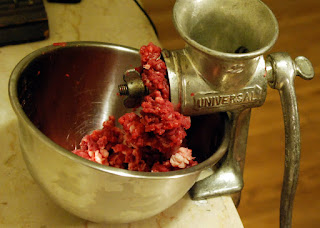
Who doesn’t like taking a hunk of raw meat and churning it through some contraption to get ground meat? Today’s Antique Modernism takes us more into the “antique” realm of things, but for modern reasons. Meat grinders come in many forms. We have one that attaches to our kitchen aid mixer and a hand crank one that was once owned by my Grandma Summerville. We’ve been using the hand crank one because the one that attaches to our mixer is also a food mill, it seems safer to have one that is dedicated to meat only.

Grinding meat is quite simple and gives you full control of what goes into your food, it can also be cheaper! First you need meat to grind, what kinds is best? We’ve gotten a few kinds of meat and chuck or sirloin seem to be the best. Don’t get taken in by the low cost of a rump roast or something you would cook in a slow-cooker. That kind of meat doesn’t do well in your ground beef as it probably won’t be braised and therefore turns into a gristly burger (trust me, I know from experience).

Ghost hand not necessary for meat chopping.

Once at home make sure your meat grinding area and equipment is clean and sanitary. Also, there is a bit of splatter, so I recommend keeping that in mind when choosing a grinding location, put on an apron for good measure. Next, chop the meat into chunks small enough to fit into your grinder. You can add raw, chopped bacon for tenderness if that’s what you like in a burger (or casserole or pasta sauce). If you want leaner beef, then added bacon probably isn’t for you. Now you grind! Usually we do a bunch at once so we weigh out 1 pound portions and put it zipper bags for freezing.


If you made it this far in the post raw meat probably doesn’t make you too queasy and hopefully you’re interested in grinding your own. I highly recommend it for many reasons. First and foremost is taste! There’s nothing like having control over the leanness or juiciness of your food. Pre-ground beef just doesn’t compare in flavor with what you can do yourself (barring meat ground in front of you at the butcher). Second is food safety, as I’ve already talk about above. You can know what’s in your food and you know the meat in your burger comes from only one cow. Third is cost, the more processed your food is, the more expensive it will be. A large chuck roast will cost less than ground beef and you’ll get more meat from it. It’s especially rewarding if you get it on sale!

Ultimately I don’t think vegetarianism is for me and as much as I like grass-fed meat, it’s not usually in the budget. Grinding meat ourselves is a great way to bridge the gap between these two worlds and stay true to our omnivore roots.

Monday, April 11, 2011

Herbs, Medicines, and a New Hobby

With the weather getting better every day, my husband and I have been out in the garden more and more. Andy suggested splitting up our gardening duties to ensure we both take responsibility for the gardening and then we can be held accountable for our areas. I thought it was a great idea because sometimes we can forget to harvest, or weed, or water. So now we each have an area to care for, which is helpful because we keep adding garden to our garden. Andy is in charge in of vegetables and I’m in charge of herbs and flowers.

Parsley and Cilantro

Additionally (since we’re not weird enough) Andy requested a medicinal herb garden. At first I wasn’t too into this request. I wasn’t sure what he was looking for. Lotions? Teas? Brews of eye of newt and children? I didn’t know where to start with a medicinal garden, which herbs to grow and how to make them into medicines. Later on Andy specified that he wants to have an herbal remedy for headaches so he doesn’t take so much ibuprofen, and the medicinal garden is an idea he got from a tour of the Hermitage. So that sounded legitimate, less backwoods hippie-ish and potential illegal, and gave me a starting point to look into which herbs would be best to grow.

I quickly back-tracked into the backwoods hippie-ish and potential illegal frame of mind when I was found Sunday afternoon browsing in the Wicca section at the bookstore. Thankfully I didn’t find anything there and instead found a fantastic book called Grow your own Drugs by James Wong (still sounds a bit potentially illegal doesn’t it?) in the crafts section. This book is great because it spells out in plain language how to make tinctures, decoctions, and poultices. My other herbalist book just says to make a tincture or a salve with such and such ingredients, but doesn’t explain how to do any of it. Already from Mr. Wong I’ve learned what a tincture is (like tea but with alcohol), how do I make it? (chop herbs and steep in vodka), and how long does it keep? (up to 5 years).

I don't have a lot of pictures of herbs yet, so here's one of our potato plants.

Mr. Wong gives his top 10 herbs to grow if you don’t have a 5 acre lot and I was happy to discover that I already had 5 of the 10 herbs prior to his sage advice: German Chamomile, lemon balm, rosemary, marigolds (not sure if they’re the right kind though), and peppermint. Pretty good for a novice eh? You can also forage for ingredients, such as horse chestnuts, and I think that sounds fun. It’ll give purpose to some of my walks with my husband. It’s best to be careful when foraging, you don’t want to eat something that looks similar to what you want but is actually toxic. I’ll be playing it very safe when foraging. But that’s just such a fun word, forage, and it’s like treasure hunting so how can I resist?

So what can I use my herbs for already? Here is a bit of information from Grow your own Drugs.

Dill: Good for easing digestive disorders and cramping, expelling gas, treating colic, toning down bad breath.
Lemon Balm: Soothe nervous tension, relieve anxiety, promote sleep, inhibit cold sores.
Parsley: Use for a diuretic, antiseptic, helps anemia, sweetens breath.
Peppermint: Soothe digestive problems, relieve pain and tension headaches, reduce muscle spasms, relieve nasal congestion.
Rosemary: Improves memory and concentration, relaxes digestive muscles, helps mild depression, also sweetens breath.
Thyme: Is an antiseptic, expectorant, soothes sore muscles and rheumatism.
Chamomile: Helps with indigestion, colic, inflamed skin, anxiety and poor sleep. This is common in tea and can ease gout, cause relaxation. It also helps with teething pain, for all of my infant readers.
Marigold: Use as an antiseptic, anti-inflammatory, and to speed up healing, soothe sunburn and minor burns.

Here are some random healing plants that I think are fun, also from Grow your own Drugs.

Elderberry: Can be anti-inflammatory for coughs, sore throats, and bronchial infections, loosens sinuses, antiviral, also use stems for creation of wand of destiny.
Hops: Not just for beer anymore! Used as a mild sedative, calms and reduces anxiety and helps with menopause.
Chili/Cayenne Pepper: Acts as a antiseptic, stimulant, skin soother by increasing circulation and desensitizing pain, protects against gastrointestinal infections.
Marshmallow: I was pretty excited to use marshmallows for a remedy, but then I found out that in this case marshmallow is a root, not a sweet, poofy treat. Soothes and reduces inflammation, expectorant and cough preventive, also can soothe and soften skin.